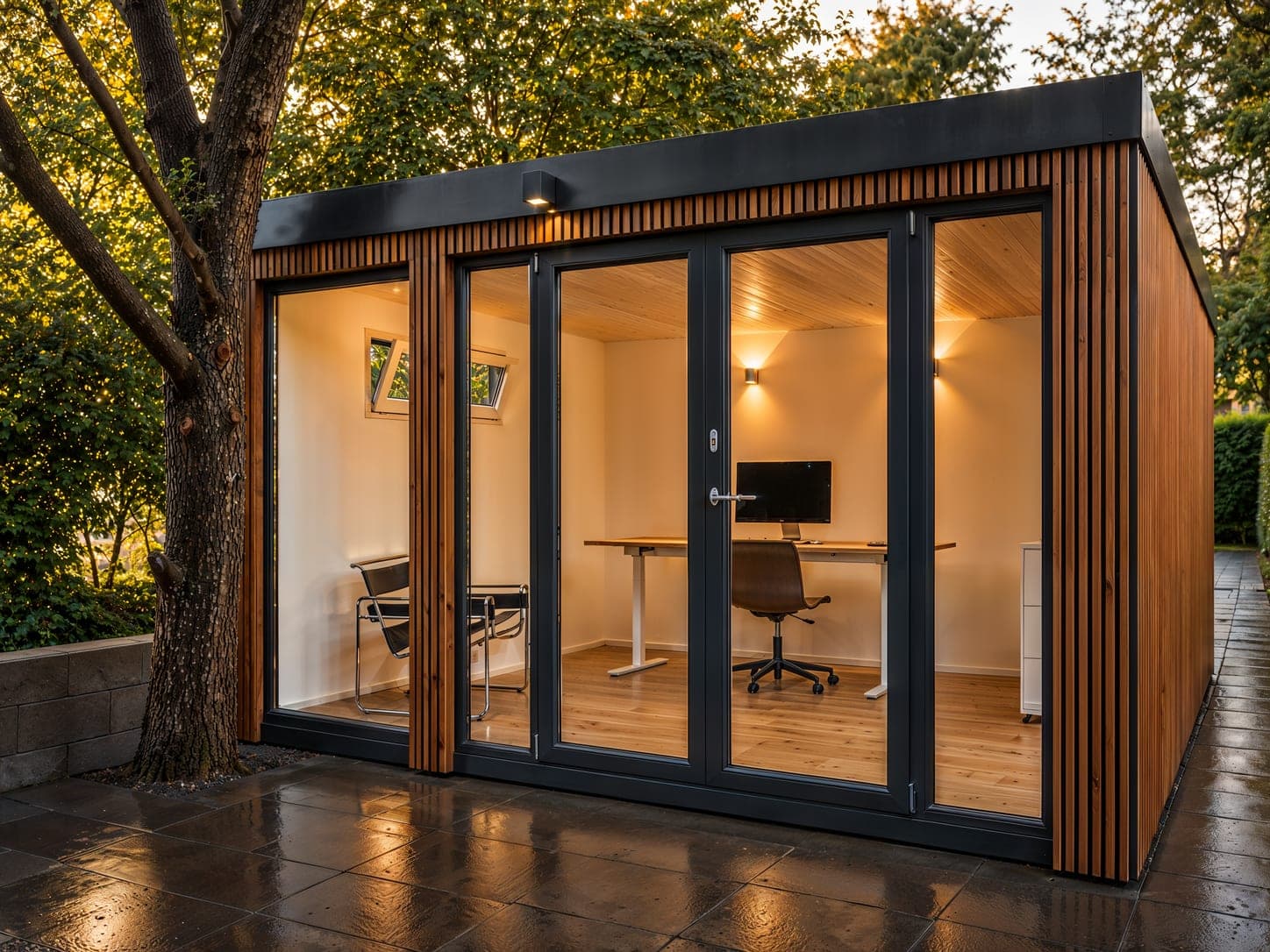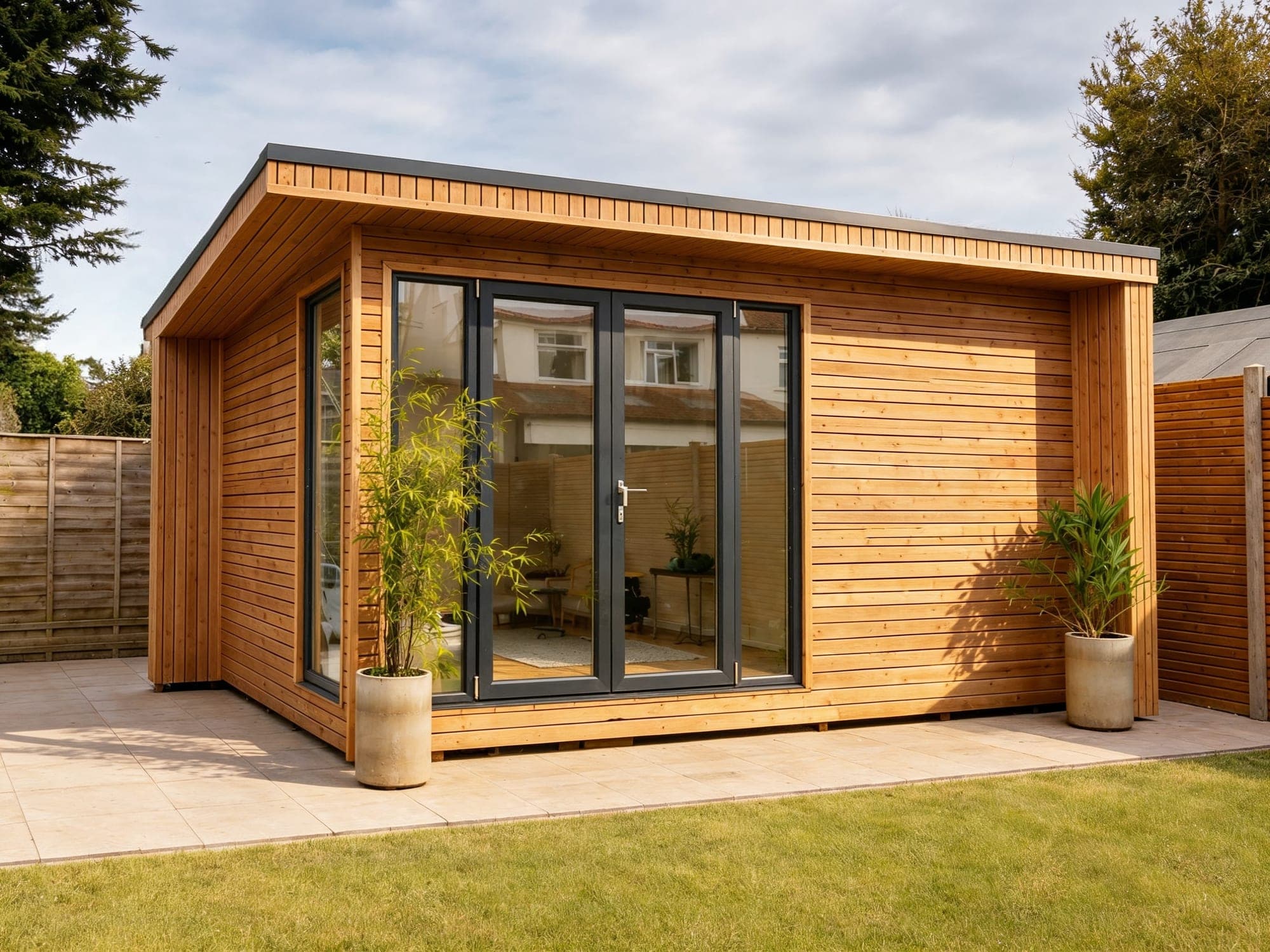
The good news first: for many buyers the garden office ends up considerably cheaper than the kit price suggests — because the tax office carries part of it. Still, so it is clear: this is orientation, not tax advice. Germany's rules on studies (Arbeitszimmer) were last changed in 2023, and whether your garden office is fully deductible depends on your specific situation. The outline, though, is manageable.
The decisive question: centre of your work?
Since 2023 a simple switch applies to studies. If the study is the centre of your entire professional activity — typical for full-time home office, self-employed people without another office, consultants, therapists, developers — you can deduct the actual costs in full. If it is not, because you mostly work elsewhere, you are left with the daily flat rate of €6 per home-office day, capped at €1,260 a year.
For a garden office that is the relevant question, not the old distinction between a domestic and a non-domestic study. If the office stands free in the garden, much speaks for treating it as a separate room; since case law on that is not uniform, your tax adviser should classify the case cleanly once.
What is deductible — and how
A garden office is a building. So you do not deduct the kit entirely in the year of purchase but depreciate it over its useful life (AfA). For an outbuilding of this kind, 2 to 3 percent a year is customary depending on classification, i.e. 33 to 50 years — for a Studio at €9,900 that is around €200 to €300 a year for the structure.
Running costs and furnishings, on the other hand, are deductible immediately or pro rata:
- Electricity for heating and equipment (pro rata via the house meter, most easily with a separate sub-meter)
- Insurance, maintenance, wood care
- Desk, chair, shelves, lighting — work equipment up to €800 net immediately, above that over its useful life
- Internet connection pro rata
The electrician, the foundation and the interior fit-out count towards the building's production cost and run through depreciation.
Employees: income-related expenses
As an employee you enter the costs in Anlage N as Werbungskosten. Your employer does not have to deny you a workplace for that; the only question is whether the garden office is the centre of your activity. Three days in the garden and two at the company usually still counts as the centre; staying home once a week does not.
Self-employed: business expenses and a warning
The self-employed claim the same items as business expenses and can additionally reclaim input VAT on the kit — 19 percent, so a good €1,580 on €9,900. That is attractive but has a flip side: with the VAT reclaim the garden office becomes business property. If you later sell the plot or close the business, the building's value is taxed as a withdrawal. For most small businesses the route is still worthwhile; whether it fits you is a calculation for the tax adviser, not the configurator.
What the tax office wants to see
- The room is used almost exclusively for work. A desk next to the lawnmower and the table-tennis table fails.
- The scale is plausible: two workstations in a Studio can be explained, a conference room for one person cannot.
- Receipts: kit invoice, electrician, foundation, running costs. Keep the build photos too — they document the completion date from which depreciation runs.
Example
Employed software developer, four days home office, Konvel Studio at €9,900 plus €1,500 electrics and foundation: around €11,400 production cost, of which roughly €230 to €340 depreciation a year, plus around €400 electricity, €150 insurance and care and a one-off €1,200 of furnishings. In the first year that adds up to a good €2,000 of income-related expenses, afterwards about €800 a year — at a 35 percent marginal rate a relief of around €700 in the first year and €280 in the following years. Over the building's life that adds up to a large part of the purchase price.
Run your case past your tax adviser before ordering — then you also know whether the VAT route pays off for you.