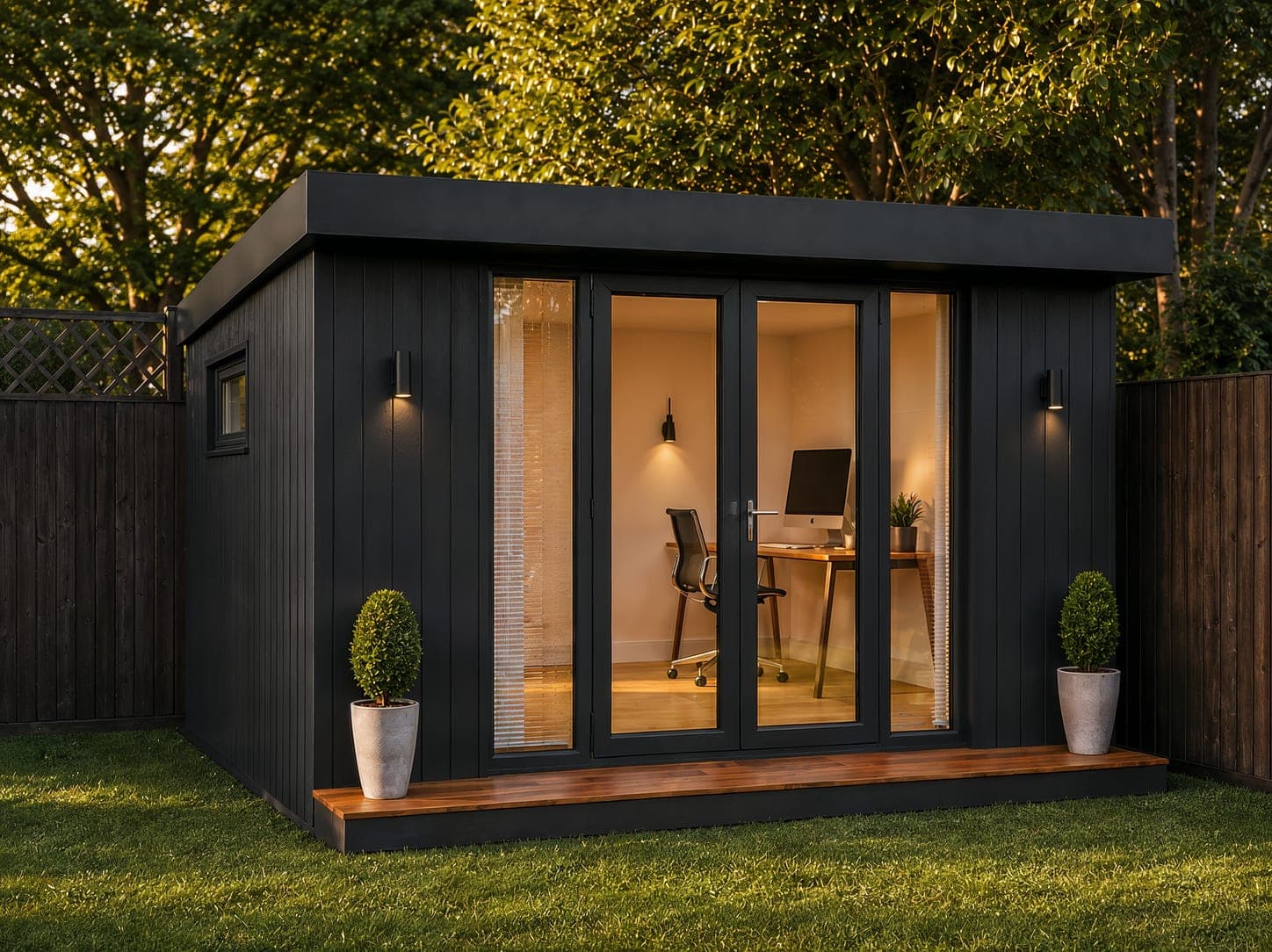
A well-insulated garden office is often the cosiest room on the property in winter: small, tight, warm in a quarter of an hour. Still, the most common worry before buying is not summer but January: will it get warm, what does that cost, and will it go mouldy? The short answer for a Konvel: yes, little, no — provided the envelope is tight and you keep two habits. Here is the arithmetic behind that.
How much heat a Konvel loses
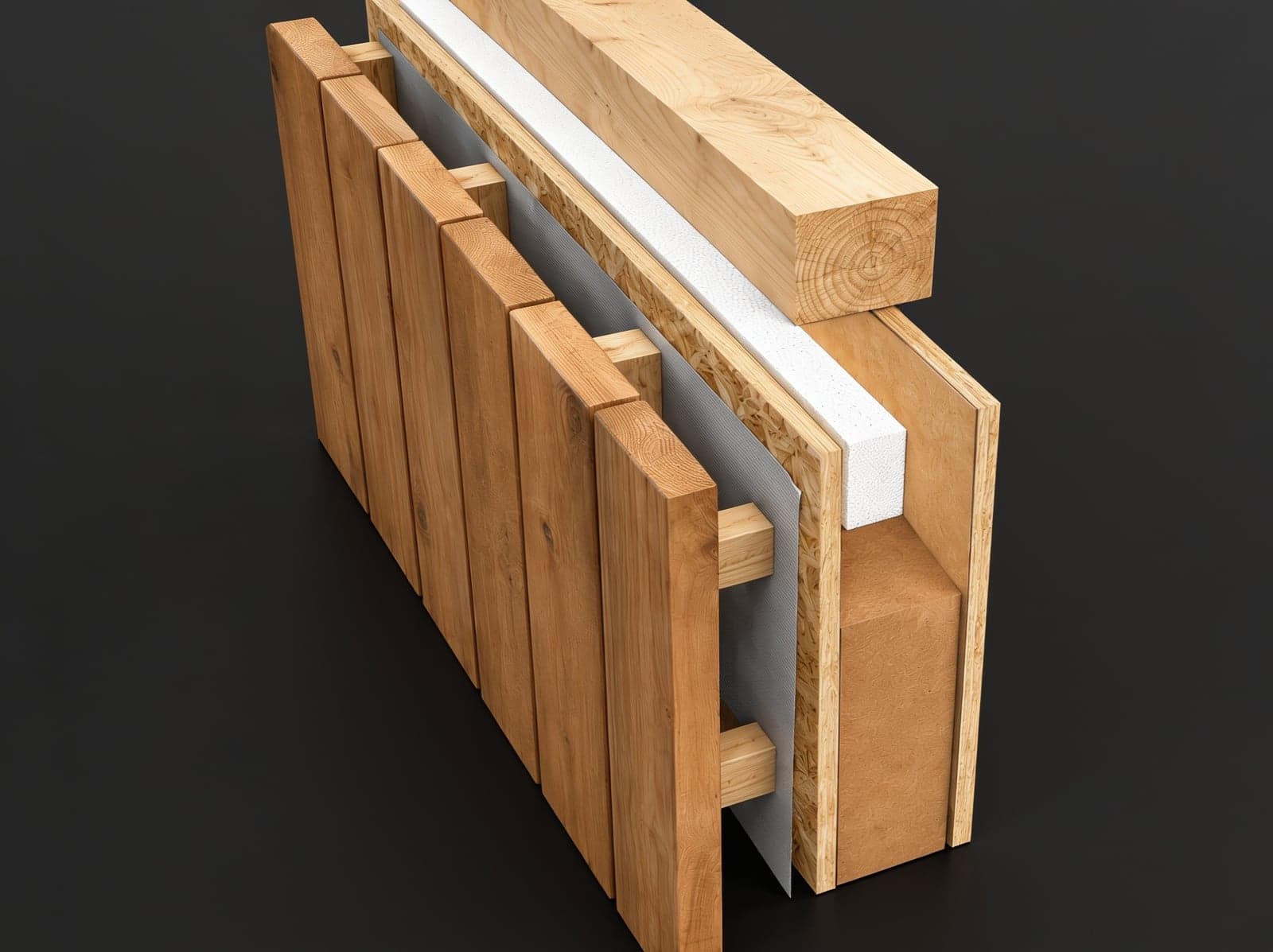
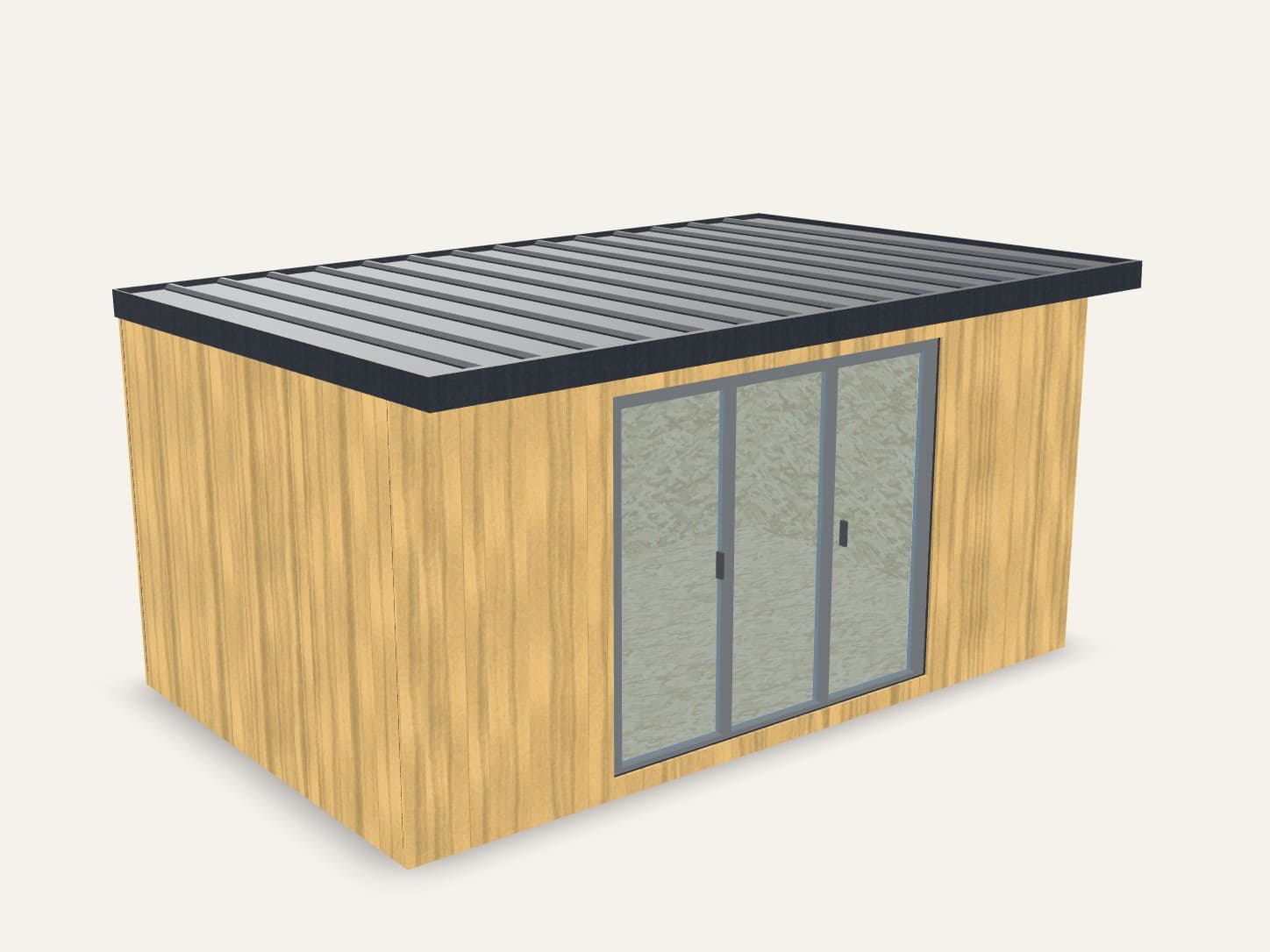
A Konvel Studio has around 66 m² of envelope: walls, floor and roof in 80 and 100 mm SIP with U-values of 0.29, 0.30 and 0.22 W/(m²·K), plus the 5 m² glass door at 1.4 W/(m²·K). Added up, the building loses about 25 watts per kelvin of temperature difference through the envelope, plus roughly 10 watts per kelvin through ventilation.
At 0 °C outside and 21 °C inside that is about 700 watts of continuous output; on a hard frost day at −10 °C around 1,100 watts. That is why a 1 to 2 kW heater is entirely sufficient — it simply cycles rather than running constantly. A 44 mm log cabin of the same size needs five to eight times as much for the same temperature, and that is why garden offices and garden sheds are two different products.
Which heating fits
- Electric wall convector, 1.5 to 2 kW. The classic: €80 to €250, with thermostat and weekly programme, connected by the electrician in five minutes. Heats the air quickly, ideal for rooms that are cold in the morning and should be warm by nine.
- Infrared panel, 600 to 900 W. Warms surfaces and people rather than the air, pleasant at the desk, very quiet. Marginal as the sole heating on frost days; combined with a small convector the most comfortable solution.
- Split air-conditioning unit with heating. The most efficient option (heat pump, factor 3 to 4), plus cooling in summer. From about €1,200 installed; pays off with daily use over many years.
What does not belong inside: gas heaters, paraffin stoves and anything with an open flame. They produce water vapour and exhaust in an airtight room — and they are not permitted in permit-free buildings anyway.
What winter costs
A working day of eight hours at 21 °C with pre-heating in the morning needs on average about 6 to 8 kWh in December or January. At €0.35 per kilowatt-hour that is €2 to €3 per working day, so €40 to €60 over a winter month with 20 working days. In the shoulder months less than half. With a split heat pump, divide those figures by three again.
The biggest lever is not the appliance but the programme: set back to 12 to 14 °C at night and at weekends instead of switching off. That costs less than heating a room chilled to 4 °C back up in the morning, and it is the most important protection against moisture.
Moisture: the two habits
A person at a desk releases around 50 grams of water into the air per hour, a coffee and a plant pot more. In an airtight room that stays inside until you ventilate. If the room cools down sharply at night, that moisture condenses on the coldest surfaces — the glass door, the corners. That is where the mould photos in the forums come from.
The SIP envelope itself is on the safe side: the vapour barrier on the inside keeps moisture out of the structure, the ventilated cladding dries the outside, the ground membrane keeps soil moisture away. The room only needs two things:
- Keep a base temperature. Never let it drop below about 12 °C, not even on holiday.
- Purge ventilation. Open the door fully for five minutes in the morning and after work. Tilt ventilation for hours chills the reveals and achieves little.
A €10 hygrometer shows whether it is working: 40 to 60 percent relative humidity is the target. If you are regularly above that, you are ventilating too rarely — not heating too little.
Summer, because the question always comes
The same insulation that makes winter pleasant keeps the heat out in summer — provided the glass door is not the south side without shading. An external blind, an awning or simply a spot with afternoon shade makes more difference than any air conditioner. The white inside and the anthracite outside of the roof are no contradiction, by the way: the PU panel between them has the best value of the whole envelope at 0.22 W/(m²·K).