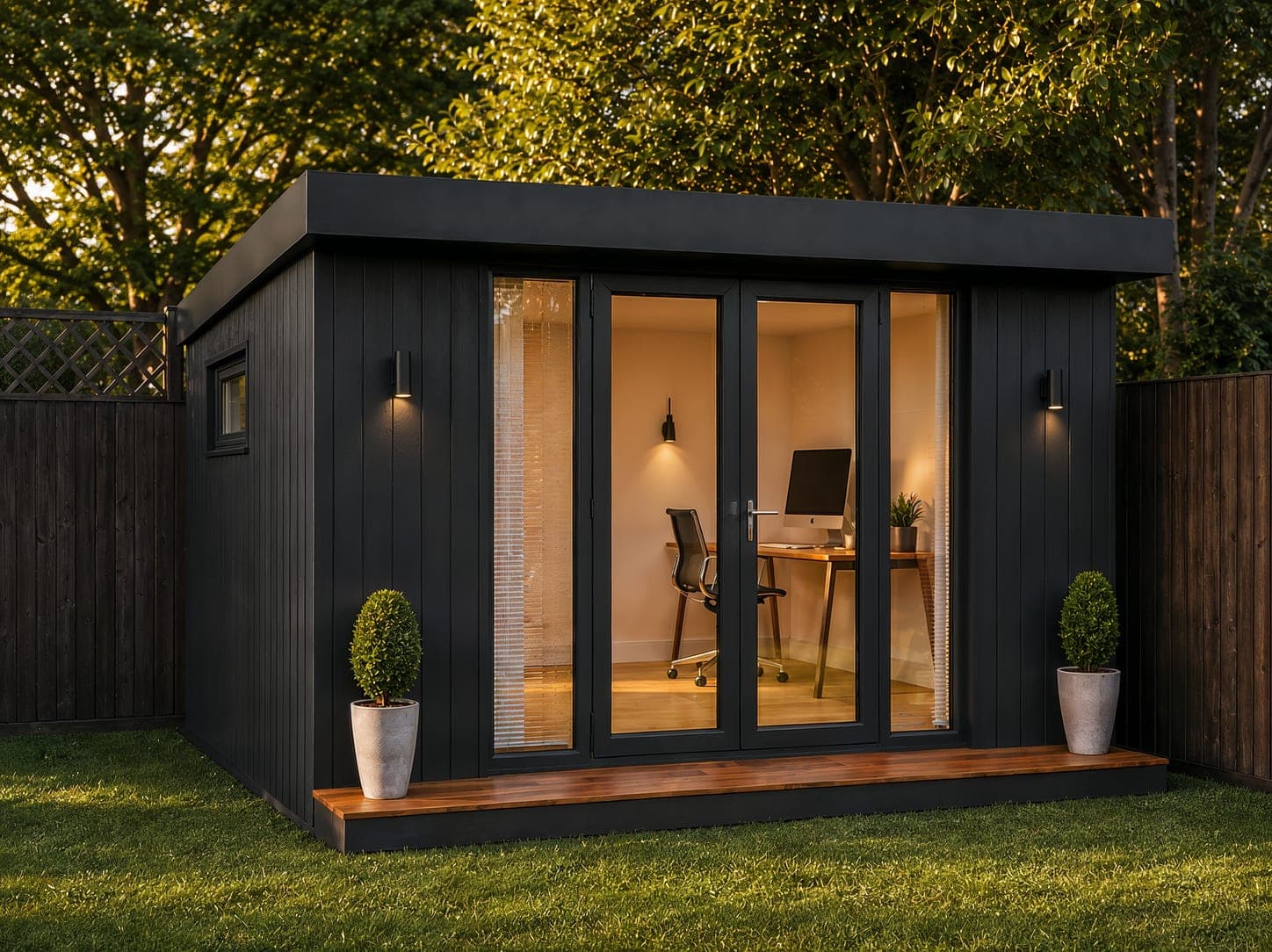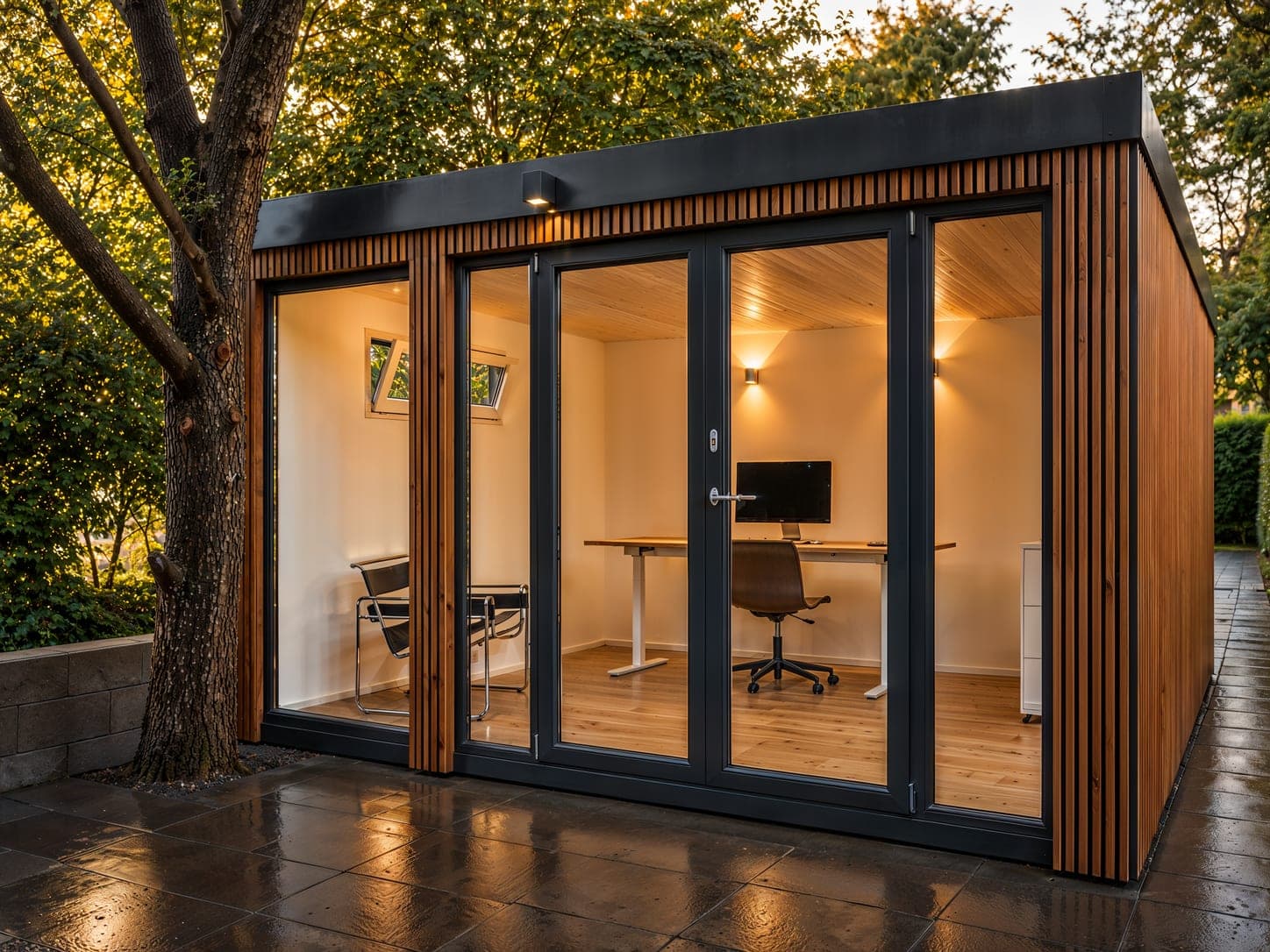
"Garden shed as an office" is one of the most searched questions around working from the garden — and usually it means a log cabin from the DIY store, insulated afterwards. This guide compares the two construction methods honestly: where log walls are enough, where they hit their limits, and why we build Konvel in SIP construction.
What the two methods are
Log cabin (Blockbohle): Solid spruce boards of 28 to 70 mm are notched at the corners and stacked. The wall is structure, facade and interior surface at once. It is the classic garden house, proven for decades, inexpensive and quick to assemble.
SIP (Structural Insulated Panel): An insulation core of 60 mm EPS between two OSB boards, factory-bonded into an 80 mm panel. The panels are screwed to a frame of KVH timber and clad outside with a ventilated facade. The wall is a sandwich, not a stack — and that is exactly what makes the difference in insulation and airtightness.
Insulation: the factor of seven
The U-value describes how much heat flows through one square metre of wall. A 44 mm log wall sits at about 2.5 W/(m²·K), a 70 mm wall at around 1.6. The 80 mm SIP wall of a Konvel achieves 0.29. That is not a little better, it is five to eight times better — and in January it means five to eight times less heating output for the same room temperature.
Log cabins can be insulated afterwards: a service cavity inside with mineral wool, vapour retarder, plasterboard. It works, but costs 80 to 120 mm of room depth on every wall, about €1,500 to €3,000 in materials plus several weekends — and the thermal bridges at the corner joints remain. The result is a house that has cost about as much as a SIP kit and still insulates worse.
Airtightness and moisture
Log walls move: they swell in autumn and shrink in summer, and the wall settles by several centimetres in the first years. That is why log cabins have settling slots above windows and doors — and why they are never fully airtight. For a tool shed that does not matter; for a heated room it means draughts, heat loss and condensation in the joints.
The SIP envelope does not move. The panels are joined with sealing tape, a vapour barrier sits inside, a facade membrane outside behind the cladding. The result: a windtight envelope in which moisture stays where you can control it by ventilating, rather than in the wall.
Assembly and weight
Both methods suit self-build, but differently. Log walls are many light parts: a weekend for the walls, but hundreds of boards, each of which has to seat cleanly. SIP is few heavy parts: a wall panel weighs 40 to 60 kg and needs two people, but the walls of a Konvel Studio stand in a day. Tools in both cases: cordless driver, spirit level, saw, tape measure.
A complete Konvel Studio weighs around 1.5 tonnes — a log cabin of the same size in 44 mm boards about the same. Neither therefore needs a concrete foundation, but a pad or ground-screw foundation.
Looks and care
Here the log cabin has an honest advantage: it looks like wood inside. With SIP you see OSB inside, which is painted or boarded with plasterboard — a smooth, bright office, not cabin character. Outside the difference is smaller than expected: a Konvel carries spruce cladding which, like any timber facade, wants oiling or staining every three to four years. The same applies to log walls — except that there the wall itself is the facade and cracks in the boards lie open directly to the weather side.
Costs over ten years
| Log cabin 44 mm, insulated afterwards | Konvel Studio (SIP) | |
|---|---|---|
| Kit | €3,500 to €6,000 | €9,900 |
| Insulation, vapour retarder, interior | €2,000 to €3,500 | €500 to €1,500 |
| Residential-grade door (instead of cabin door) | €1,200 to €2,000 | included |
| Heating cost per winter (estimate) | €250 to €400 | €100 to €180 |
| After 10 years, roughly | €10,000 to €15,500 | €11,400 to €13,200 |
The range shows what this is about: a log cabin is cheap as long as it stays a garden house. As soon as it is to be a year-round office, it catches up with the cost of a SIP kit — and still lags technically.
When a log cabin is the right choice
If you mainly use the room from April to October, need a workshop or a summer office, and the wood look inside matters to you, a good log cabin with a 70 mm wall is a sensible decision. If you want to work in it five days a week, in February too, with video calls and a computer that should not overheat, then insulation is not a matter of equipment but the foundation — and that is what SIP is built for.
Either way: a room of your own in the garden where you can work undisturbed is one of the best investments in your working day that a kit can buy.